
by Jerome Valero ( @Jro_88 )
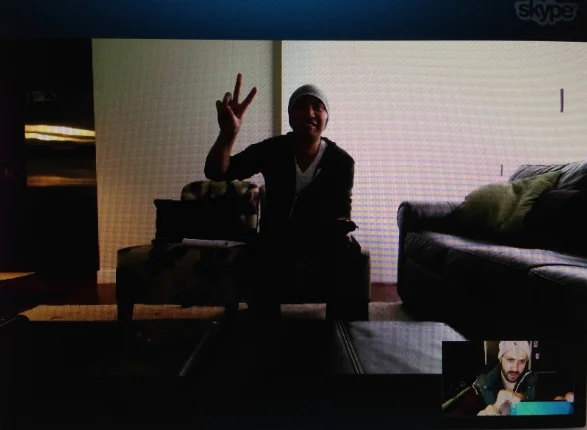
Ryan Star is a busy man. Our Skype interview is sandwiched neatly between an early morning appearance at a New York ASPCA adoption drive and a late afternoon deadline to write a Newsday review of last night’s Madison Square Garden concert of one of his personal heroes, fellow Long Islander Billy Joel. While Star speaks excitedly about the release of his third full length album, the independently-produced A N G E L S + A N I M A L S, the enthusiasm he conveys in describing his entire day’s schedule foreshadows the image of an artist genuinely happy with his place in the world.
Star is streaming from inside his home recording studio in Brooklyn, where much of A N G E L S + A N I M A L S was born. Despite the cozy setting, Star is bundled in a hoodie and vest, a sure sign that the world’s longest Winter has stretched well past its departure date. As someone who’s followed his career, from Stage, Star’s first band, to his appearance on the cult hit Rock Star Supernova, bookmarked in between by the release of his first solo album, 2005’s “Songs From the Eye of an Elephant” and his major record debut, “11:59” in 2010, I’m admittedly eager to get comfy, dive in and hear his perspective on the most mature record in his repertoire to date.
“It’s the toughest thing I’ve ever created”
A N G E L S + A N I M A L S is a “journey”, as Star describes it: an 11-track narrative of finding and losing love, before ultimately recapturing it. From the album’s opening track, ‘Sailing On’ (“If you promise me the sun is right behind the haze”), to the Bon Iver-inspired odyssey ‘Fuck’n Up’ (“What are you wasting your life for?) and closer ‘Where the Island Ends’ (“We scream into the sky to tell them who we are”), A N G E L S + A N I M A L S is full of soaring melodies borne from an artist whose DNA is equal parts Pearl Jam and Frank Ocean, Nine Inch Nails and The National. “The older material taught me how to be. That’s my chemical makeup,” explains Star. “Then the newer stuff, James Blake, Bon Iver; they capture an intimacy and energy that I’m really excited about.”
Star is well-connected to his legion of fans online, with a loyal following on social media; to date, countless official, live and cover versions of his songs, including impromptu sing-alongs on the street and inside bars across the country, together have garnered millions of views on YouTube. So how does Star feel when his fans approach him with tales of being inspired by his music, much the same way Star was moved by his heroes? “I know the level of respect you’re talking about when somebody says that to me because that’s what I would say to Eddie Vedder, to Leonard Cohen, to Michael Stipe, to Tori Amos. I know that feeling. When someone says it to me, it’s like a warm hug.” Star continues, “Art inspires art is the coolest thing. It’s an evolution: the ‘Standing on the Shoulders of Giants’ idea. That is the ultimate compliment.”
It is perhaps this support from his ever-expanding fan-base that gave Star the confidence to forego releasing A N G E L S + A N I M A L S through a major record label, instead opting to produce the album entirely on his own. Critical fan-sourced funding through PledgeMusic ultimately ensured the album would be released. While this newfound independent route gave Star the creative control a recording artist always dreams about, it wasn’t the glamorous path one might imagine.
“Have you seen ‘Indie Game: The Movie?’”, asks Star, deftly acknowledging the inner fanboy in me using an Xbox One to Skype with him today. The documentary in question follows the struggles of three independent video game creators trying to find their own way in a world of multi-million dollar blockbuster game productions. “I related to that so much because they are competing with gaming companies who have thousands of people. I’m making a really competitive record but doing it completely on my own, literally, with everything going through my hands. It was quite the endeavor to do.” When pressed as to how the album would have sounded if released by a traditional record label, Star is adamant: “I tried to dance that dance. There’s a filter that happens where they look at everything else on the radio. At one point, whistles were popular and they’ll say, ‘Hit songs have whistles!’ It’s just not in me to chase these things…,” he pauses, before adding, “Creatively, I feel so proud and committed to the new album that it opened me up to be excited to make music again. There’s something right about that.”
“Ryan, you’ve got one take to get it.”
Clubhouse Studios, a fully renovated music recording facility converted from a rustic 19th century barn, is located just outside Rhinebeck, a couple of hours north of Brooklyn. Renowned for the pure sonic quality of their recordings, Star had access to much of the classic analog equipment at Clubhouse to record A N G E L S + A N I M A L S, seemingly to try to capture a genuine feeling in the sound that at times lacks in this age of digital perfection. “What I find is perfect is kind of…. all level”, Star explains while wavering a raised hand across the screen. “Then there’s eccentric things that happen when you see, for example, a beautiful person and there’s a little imperfection; there’s a freckle in the wrong spot. That’s extra beautiful. Your uniqueness comes out.” Circling back to the state of radio play today, Star ponders, before adding, “I don’t think you hear that in music a lot because you can easily do things and get it perfect. We can tweak it and do a hundred takes and make you sound like the best guitar player ever made.”
He would argue, though, that recording in analog alone was less a factor in the album’s authenticity than his overriding intention to celebrate those imperfections captured with his live band in the studio. “On ‘Fuck’n Up’, I gave myself one take. It took me two weeks to get that one take, but I didn’t want to edit it. I needed that song to be a full story,” explains Star. “This is why the album has a raw feeling in a modern sound. A N G E L S + A N I M A L S captures this raw, primitive future… this raw version of modern music. That to me is more ‘analog’ than how I recorded it.”
“The cost of being a muse.”
There’s a scene in the 2000 film Almost Famous where William Miller, a budding rock journalist, finally convinces the lead guitarist of Stillwater to sit down for an interview he’s chased the entire tour. William begins his interview by asking, “Do you have to be depressed to write a sad song? Do you have to be in love to write a love song? Is a song better when it really happened to you?” I pose the same questions and, after some collective admiration of Cameron Crowe, Star responds, “Let’s hit these questions, because I don’t think he answered them in the movie.”
“No, you don’t have to be depressed to write a sad song,” he begins. “To be in love to write a love song? For me, for me, yes. There’s one concentrated moment that I’ve been pulling from—I’ve been writing about that 10 seconds of my life since that moment happened years ago.” Star adds, “I think one of the best songs I’ve ever written is ‘My Life With You.’ The truth behind that is so important. To sell it. To believe it. To sing it.”
The last question garners the strongest response. “I’m going to say yes. I think years ago, I would have said no. For me, the truth now brings me closer to something. We’ll create a sound, and the intention behind making it, saying ‘Here...,’” Star raises his hands as if to present an offering. “Here’s something that you not only hear. That’s when something hits you. If it’s coming from a real place, it’s truth. I think you will hear that. You will feel that.” These are perhaps the answers William Miller sought in understanding why music affects the devoted so deeply. “I can see Stevie Nicks writing Landslide in the Aspen mountains in Colorado. I believe that the intention behind that, based in truth, speaks. We hear it not with our ears. Something else happens, and that’s when music changes us.”
If the truth in Star’s music lies in those pivotal 10 seconds, where love can be found or lost, is that love ready to have its story told to the world? “That’s the cost of being a muse,” responds Star, with a tone closer to enthusiasm than regret. “I think they’re ok with that. They realize when I’m more honest, everything’s better. I’m happier. Being inspired… it’s very private but yet it’s so public. I want it to be so public. It’s not a little gift that you keep under the bed or a pillow. It’s the bigger gift of how far it can get out there. I think a muse would be proud. That’s their job and I think they’re happy.”
“Do you. Be you.”
In every music enthusiast’s life, he or she will have those two or three bands who define a part of who they are, whose songs recall vivid memories of years past, and whose last listen will garner the same emotional response as the first. Ryan Star may very well be on my list. ’11:59’ gets me up in the morning, while A N G E L S + A N I M A L S is the soundtrack to hope and longing that comes around so rarely it should be celebrated every time it is discovered. I’ve long lost how many times I’ve listened to ‘Songs from the Eye of an Elephant’; I contemplate whether this first album is his masterpiece—a completely stripped down, honest and vulnerable body of work.
I divulge this admiration to Star, who humbly tells me this story: “You know those Boss guitar effects pedals? They’re like the beginner pedals, they’re great pedals but they’re considered the mass produced pedals. But then you find the boutique stuff. The ‘Whoa, analog this!’ stuff. Dan Tirer, my guitarist, started with those Boss pedals, then got into the analog boutique stuff and learned how to use it and got really intellectual about it. Then, after all of that, Dan realized those Boss pedals are the best! There’s a purity and perfectness about them so he comes back to them. And now Dan only uses those again, but now he plays them way differently than if he never took that journey.”
Star then relates back to ‘Elephant’: “Creatively, you do that. You find this thing you don’t completely understand. You move on and try different things and push different limits. Now the idea of me coming back to that idea with what I know now might be really cool. That’s where I think I’m headed next, to do my version of that with what I know now—with the truth, the intentions and the honesty that I’ve come to know in my songwriting.”
Almost Famous ends with William Miller asking the question, “What do you love about music?” It’s something I don’t ask Star, realizing it is his truths, intentions and honesty that form the core of what fans love about his music, and it’s Star’s own love of making music—his vision of his music—and putting it out into the world that continues to drive him to create. Perhaps it’s fitting, then, that Star leaves with this message: “A N G E L S + A N I M A L S is my best work and I’m getting closer to the heart of who I am. The biggest thing I learned from A N G E L S + A N I M A L S is to ‘Do you. Be you.’ It’s easy to say, but there’s a time in everyone’s life, hopefully, where they really understand that. I have heard it my whole life, and you’re like, ‘Of course, that’s right.’”
“But when it hits you and you really become that, then you’re powerful. Nobody can tell you otherwise, because only you know. And that’s a good feeling to have. I’ll say it makes me feel excited about the future, about what I’m going to do next.”